Vietnam Travel Guide
BRIEF INTRODUCTION
A land of contrasts, Vietnam is both delicate and intense, traditional and forward-looking. Its recent history, marked by war and resilience, is merely the surface of a much older, richer narrative that stretches back millennia, through the dynasties of emperors, the teachings of Confucian scholars, and the rhythm of village life that continues almost unchanged in the countryside.
PRACTICAL INFORMATION
Visa and entry requirements
This information is accurate as of June 2025. For the most current and reliable updates, please refer to the official website and confirm the details prior to your departure. Citizens of several countries can enter Vietnam without a visa for stays of 14 to 45 days, depending on nationality. Notably:
- ASEAN countries: Citizens from Cambodia, Indonesia, Laos, Malaysia, Singapore, Thailand, and Myanmar can stay up to 30 days without a visa.
- Other countries: Citizens of Japan, South Korea, Russia, France, Germany, the UK, and several others can stay up to 15 days without a visa.
Certain European and U.S. citizens require a visa to enter Vietnam for tourism, business, or other purposes.
E-Visa (Electronic Visa):
- Available to citizens of 80 countries.
- Validity: Up to 90 days, for both single and multiple entries.
- Application: Submit online with required documents and payment.
- We would recommend that you verify visa eligibility with us before you arrive.
Visa on Arrival (VOA):
- Eligibility: Applicable for air travelers arriving at specific international airports in Vietnam.
- Pre-Approval Letter: Must obtain an approval letter before departure.
- Fees: Stamping fee at the airport: $25 USD for a single-entry visa.
For the most current and reliable updates, you can visit the official website and confirm the details before you leave. Regardless of the visa type, all travelers must ensure their passport is valid for at least 6 months beyond their intended stay and has at least 2 or 3 blank pages.
IMPORTANT
If your flight to Vietnam transits through Thailand, you must complete the Thailand Digital Arrival Card before travel. Foreigners are required to submit their arrival card information at least 3 days before their arrival date in Thailand. Submit the form online at https://tdac.immigration.go.th/arrival-card/#/home
Electricity
Vietnam uses a 220V, 50Hz electrical system, similar to the EU standard. Sockets vary widely, ranging from Type A (flat pins) to Type C (round pins) and sometimes Type D (three round pins). Because there is no strict national standard, you may find different socket types from place to place, so bringing a universal adapter is the safest choice. Many modern hotels now offer universal outlets, and most electronics like phone chargers can handle the voltage. Electricity in the countryside can be unstable, so carry enough charged batteries to run your equipment for two to three days without mains power. In some remote areas, you may even come across 110V outlets, so always check before plugging in your device.
Internet and SIM cards
Vietnam is one of Southeast Asia’s most digitally connected nations, with fast and affordable mobile internet available almost everywhere. Major cities like Hanoi, Ho Chi Minh City, and Da Nang offer widespread 4G/LTE coverage, and even many rural areas maintain stable connections. Official 5G services began in October 2024, and by mid-2025, they reached around 26% of the population. Another increasingly popular option is the E-Sim (Electronic Sim). If your phone supports it (most modern smartphones do), you can purchase and install the virtual Sim before departure, so your phone connects automatically upon landing.
Note: If using a local Sim or E-Sim, your home-country number will be inactive, but WhatsApp and similar apps remain functional if account settings aren’t changed.
SIM cards are inexpensive and easy to obtain upon arrival, either at airport kiosks or convenience stores. Leading providers include Viettel, Mobifone, and Vinaphone, all offering reliable coverage and data packages tailored for short-term travelers. A typical tourist SIM with 15–30 GB of high-speed data costs around $5–10 USD and is valid for 30 days. Wi-Fi is widely available in hotels, cafes, and restaurants, often free and reasonably fast. Most accommodations, even in smaller towns, include Wi-Fi as a standard amenity.
Tip: Be sure your phone is unlocked before arrival. If using eSIM, major providers now support digital activation, making the process even smoother for tech-savvy travelers.
Currency and Money
The local currency is called the Dong. Please verify the USD=VND exchange rate here. As of June 2025:
- 1 USD ≈ 26,197 VND
- 1 EUR ≈ 30,144 VND
Preferred Currencies: US Dollars (USD) and Euros (EUR) are commonly accepted for exchange in Vietnam. Other Currencies: British Pounds (GBP) and Chinese Yuan (CNY) can also be exchanged in major cities. Some currency exchange bureaux are open 24/7. We recommend changing money only in banks, hotels, and currency exchange bureaux. Credit cards are accepted at upscale urban establishments, but may not be usable in rural areas or at smaller businesses.
- Urban Areas: Currency exchange services are widely available in cities like Hanoi and Ho Chi Minh City. Options include banks, hotels, and authorized exchange bureaux.
- Rural Areas: Access to currency exchange and ATMs can be limited in remote regions. It's advisable to exchange sufficient funds before leaving major cities.
- Re-Exchanging Dong: While it's possible to convert leftover Dong back to foreign currency at airports, be aware that exchange rates may be less favorable, or keep your Dong and show your friends back home how you turned a millionaire overnight!
IMPORTANT
If you bring foreign currency notes (USD or EUR), ensure the bills are new, clean, and free from marks or tears. For US dollars, bills issued before 2006 are often not accepted due to counterfeiting concerns. Larger denominations, such as USD 100 or EUR 100, are generally easier to exchange and offer better rates.
Tips (Gratuities)
Providing a tip is not obligatory, but it is customary to show appreciation for the exceptional service rendered by professionals who support your journey in the tourism sector. Here are our recommendations for tipping:
- Guides (for a couple): USD 12 – USD 15 per couple per day
- Guides (for a group of 3–10 people): USD 7 – USD 10 per person per day
- Guides (for groups above 10): USD 5 – USD 7 per person per day
- Drivers (for a couple): USD 12 – USD 15 per couple per day
- Drivers (for a group of 3–10 people): USD 7 – USD 10 per person per day
- Drivers (for groups above 10): USD 5 – USD 7 per person per day
- Hotel Maid Service: USD 1 – USD 2 per day
- Porters: USD 1 – USD 2 per luggage
- Local Boat Transport: USD 2 – USD 3 per boat
- Overnight Cruise: USD 5 – USD 10 per night per traveler (covers all crew)
Ultimately, while tipping is not obligatory, it contributes meaningfully to the livelihoods of those who ensure your journey runs smoothly and is regarded as a mark of cultural respect and appreciation.
Personal expenses
Before your trip, please review your proposal carefully to understand what is included in your package and what is not. If you're not sure, please get in touch with us. Travelers mainly need money for souvenirs, extra food and drinks, communication, laundry, and other personal expenses. We recommend budgeting about $50 USD per person per day for it, but adjust based on your shopping habits or drink preferences.
Important Considerations:
- Communication: Costs for SIM cards, internet data plans, or international calls should be considered.
- Laundry: Most hotels offer laundry services, which may incur an extra charge.
- Meals: If you are traveling with us on a private trip, we have likely included only breakfasts in the trip price. You will need to pay for your own lunches and dinners. Meals can range from about 5 USD at a street stall to 30 USD or more per person at an upscale restaurant.
International grocery chains in Vietnam are primarily located in major cities such as Hanoi, Ho Chi Minh City, and Da Nang. Supermarket brands like Big C (French-owned), Lotte Mart (Korean), and Aeon Mall (Japanese) offer a broad selection of imported food products, catering to both expatriates and affluent local consumers. Convenience store chains, including 7-Eleven and Circle K, are widespread in urban areas. Outside major cities and tourist hubs, the availability of international grocery items diminishes significantly, with most imported goods accessible only through specialty stores or hotel shops.
Health
We are not authorized to provide medical advice. Please consult your doctor before your trip about vaccinations or precautions. If you take regular medication, bring enough for the entire trip, as some medicines are hard to find outside of your country. Always carry medications in your hand luggage, not checked baggage. Medical record and liability release: All travelers must complete and sign a trip application form, which includes these documents.
Vietnam offers a healthcare system that is generally adequate in urban centers but more limited in rural or remote areas. Major cities such as Hanoi, Ho Chi Minh City, and Da Nang host modern hospitals, private clinics, and international-standard medical facilities, some with English-speaking staff. Outside these urban centers, medical infrastructure is basic, and serious cases may require evacuation to Thailand, Singapore, or other nearby countries. Travelers should be aware of mosquito-borne illnesses, including dengue fever, Japanese encephalitis, and malaria in certain rural and forested areas, particularly during the rainy season (May–October). Water and food-borne illnesses such as travelers’ diarrhea, hepatitis A, and typhoid are possible, so bottled or boiled water and well-cooked meals are recommended. Urban air quality may occasionally affect those with respiratory sensitivities. Rabies exists in stray animals, so bites or scratches require prompt medical attention. Drink only bottled or purified water. Eat thoroughly cooked food and exercise caution with raw vegetables or unpeeled fruits.
Travel Health Insurance
Valid travel insurance is mandatory for all travelers. Your policy must cover medical evacuation, including emergency air transport back to your home country. Carry both printed and digital copies of your insurance certificate, along with your policy number and your insurer’s 24/7 emergency contact details. If anything unexpected happens during your trip, our team and local partners will assist where possible, including helping you communicate with medical staff and your insurance company.
Accommodations
Vietnam offers a wide range of accommodations, from simple village homestays where you sleep on thin mattresses in shared family spaces, to luxurious resorts. In major cities and near key tourist sites, options range from guesthouses to high-end hotels. Unless otherwise requested, we typically reserve four-star hotels. When a four-star option is unavailable, we select the next-best option, often a three-star property or, occasionally, a well-kept guesthouse or homestay. Standard hotel check-in is at 2 PM, and check-out is at 11 AM. Many hotels allow early check-in if rooms are available, but to guarantee this, we recommend arranging it in advance; supplements may apply. For late check-outs, it's best to ask the hotel reception the night before departure, though many properties offer a 2-4-hour grace period. If you're considering a triple room, be aware that few hotels in Vietnam offer proper triple rooms. Most offer a double bed with a rollaway, or a twin room with a fold-out bed. These setups may feel cramped, and the extra bed can be uncomfortable. We can book a triple room if needed, but we recommend keeping these limitations in mind. When selecting accommodations, we consider location, service standards, renovation history, booking flexibility, and value. We also prioritize practical details like breakfast quality, room cleanliness, and service responsiveness. Hotel standards can change over time, so we greatly value your feedback to help keep our recommendations accurate and up to date.
Transportation and Travel
Vietnam is a vast country, or more accurately, a very long country. We work with locals who specialize in providing cars and local drivers familiar with the region's routes. It is rare for drivers to speak English, so unless it is a short transfer (mainly to/from airports) or to/from Ha Long Bay. We would never provide a driver without our guide to assist with translation. The farther you travel from central locations, the more likely you are to travel in older cars. In some areas, such as the mountainous regions of north-west and north-east Vietnam, we might need to use 4WD vehicles. Due to the rough terrain and winding roads in the far north (Sapa area), we will not use buses, even for larger groups, and will split the group across several vehicles. If you specifically request it, we can provide you with a more luxurious vehicle, but you will pay a very high rental fee.
NOTE
If you are traveling with heavy or multiple pieces of luggage and your itinerary includes train travel, we recommend arranging luggage transfer in advance. Luggage space on trains is limited, and handling large bags can be inconvenient. Please refer to your trip proposal, and contact us if you would like us to arrange separate luggage delivery for an additional fee, so you can travel comfortably and hands-free.
Flights and Baggage
Vietnam is served by three main international gateways: Noi Bai (Hanoi) in the north, Tan Son Nhat (Ho Chi Minh City) in the south, and Da Nang in the center, providing easy access to the country’s key regions. Additional airports, such as Phu Quoc, Cam Ranh (Nha Trang), and Dalat, also handle increasing numbers of international flights. For domestic travel, these hubs connect to a vast network of regional airports, linking major cities with popular destinations such as Phu Quoc, Nha Trang, Dalat, Hai Phong, and Quy Nhon, making air travel the most efficient way to cover Vietnam’s long distances. For most international and domestic flights within or into Vietnam, the standard checked baggage allowance is 20 kg (44 lbs) per person, typically limited to one piece of luggage. Airlines may impose additional charges for excess baggage, calculated per kilogram or per extra item, and fees can be exceptionally high on regional routes.
Carry-on baggage policies vary by airline, but as a general rule, the size should not exceed 55 x 35 x 15 cm (approximately 21 x 14 x 6 inches), and the weight limit is usually 5 kg (11 lbs). Some low-cost or regional carriers may be stricter.
Food
Vietnamese cuisine is shaped by history, geography, and a long tradition of balancing fresh herbs, bright flavors, and simple cooking techniques. Centuries of regional trade, Chinese influence in the north, Khmer influence in the south, and French colonial presence have all left their mark. Still, the core of Vietnamese food remains unmistakably its own: light, fragrant, and built on contrast. A meal is rarely one note; sweet, salty, sour, spicy, and umami sit together in harmony. For travelers, the food is approachable, fresh, and easy to enjoy. Street food culture is strong, but so are family-run eateries and simple cafés serving deeply comforting dishes. Hygiene standards vary, so follow your guide’s recommendations and choose busy stalls with high turnover.
Must-try dishes
- Phở: Vietnam’s iconic noodle soup, typically made with beef or chicken, served with fresh herbs, lime, and chili.
- Bánh Mì: A French-influenced Vietnamese baguette sandwich, filled with pâté, pickled vegetables, herbs, and various meats.
- Gỏi Cuốn (Fresh Spring Rolls): Rice-paper rolls packed with shrimp, herbs, vermicelli, and greens; served with a light dipping sauce.
- Bún Chả: Grilled pork served with vermicelli noodles, fresh herbs, and a sweet-savory dipping sauce; famously associated with Hanoi.
- Cao Lầu: A distinctive noodle dish from Hội An, featuring thick noodles, herbs, and slices of pork with minimal broth.
- Cà phê sữa đá: Strong drip coffee with condensed milk, a must-try for coffee lovers.
Vietnamese cuisine is not heavy or overly spicy. It relies on fresh greens, fish sauce, lime, grilled meats, slow-cooked broths, and rice in countless forms. Even picky eaters tend to find dishes they enjoy, while adventurous travelers discover flavors they remember long after the trip ends.
Cultural Etiquette & Modesty Norms
Vietnamese society blends Confucian values with socialist principles, emphasizing respect, modesty, and harmony over individualism. Being culturally sensitive will enhance your experience and interactions throughout the country.
Respect and Social Etiquette
- Respect for Elders and Authority: Age and status matter. Please use polite titles when addressing elders or superiors.
- People are generally addressed by their given name (first name) rather than by their family name.
- Saving Face: Avoid confrontation, criticism, or causing embarrassment. Indirect communication is valued.
- Modesty: The Vietnamese value humility. Avoid boasting or assertive behavior.
- Community welfare is prioritized over personal gain. Cooperation is key.
- Gift-Giving: A typical gesture of goodwill, offer gifts with both hands when visiting homes or businesses.
- Body Language: Do not touch the head or point with your feet. Greet with a gentle handshake (same sex) or a slight bow.
Social Interaction Guidelines
- Please try to be on time and speak gently. Overly loud voices and flamboyant gestures are discouraged.
- Try to avoid public displays of affection and sensitive topics like politics or the Vietnam War.
- Dress modestly, especially in temples or memorials.
- Use both hands when passing items.
- Do not stand with crossed arms or hands on your hips.
- Please always ask for permission before you take photos, especially in rural or sensitive areas.
Dining Etiquette: Dining in Vietnam is considered a refined act, and good table manners are expected. If invited to a local home:
- Bring a modest gift such as fruit or sweets (avoid anything black, yellow flowers, or expensive gifts).
- Please wait to be seated and let the elders sit first.
- You can always pass items with both hands.
- Rest your chopsticks between bites; don’t talk while holding them.
- Hold bowls close to your mouth; use your left hand for soup spoons.
- Please finish your plate as a sign of appreciation.
- At the end, rest chopsticks horizontally atop your bowl.
- Public drinking is rare among women, and smoking is more common among men.
Superstition and Beliefs: Superstitions in Vietnam coexist alongside modern education and influence both private and public life:
- Many people consult astrologers before major decisions, including marriage, travel, and business.
- Traditional beliefs hold that astrological compatibility is essential in relationships.
- Efforts to ban fortune-telling persist, but superstition remains deeply embedded in daily culture.
Even highly educated individuals may act based on ancestral wisdom or spiritual beliefs, reflecting the cultural depth and complexity of Vietnamese society.
Weather and Recommended Seasons
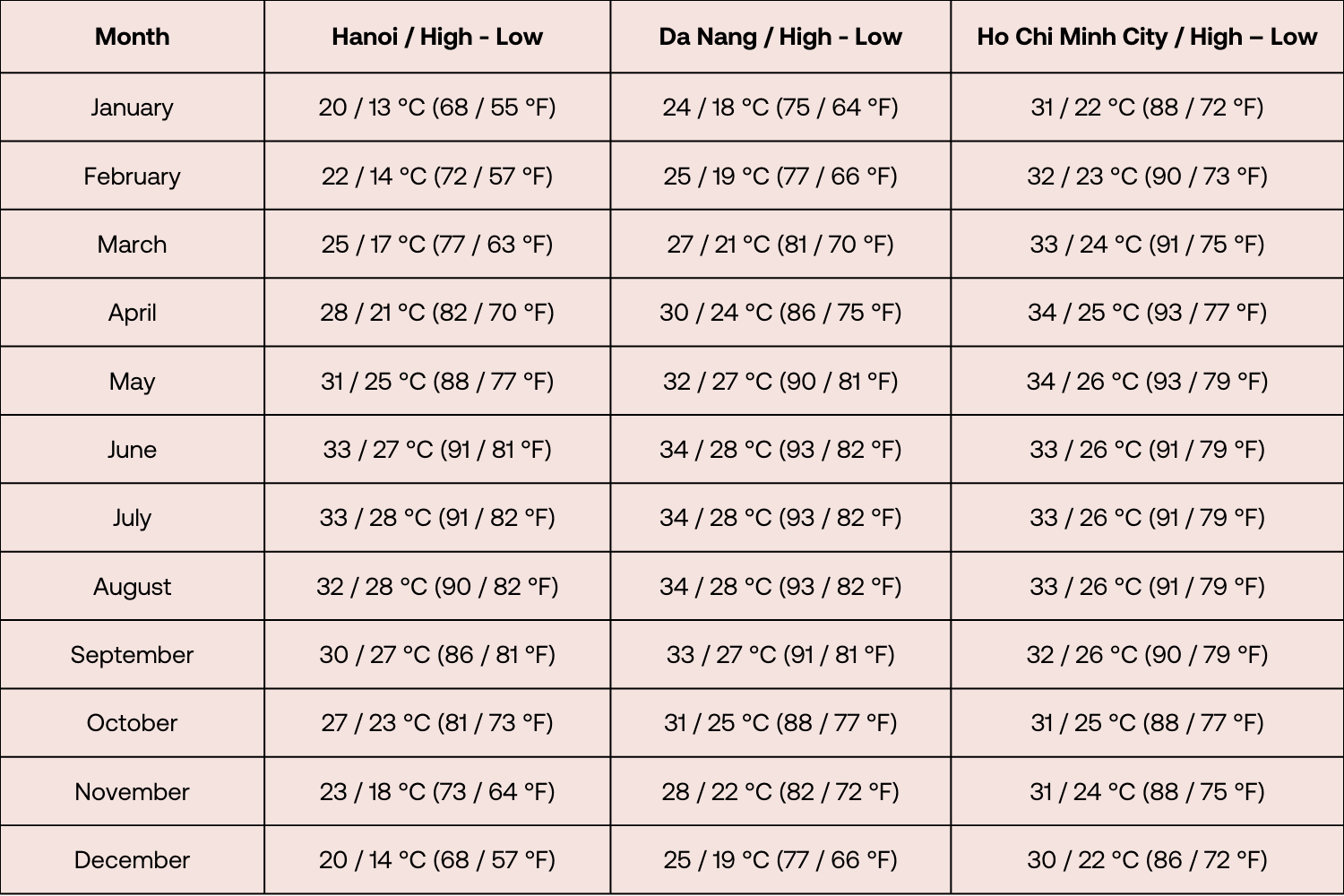
As a rule, the country is tropical in the south and monsoonal in the north with a hot, rainy season from May to September and a warm, dry season from October to March. However, the complex topography of the vast flat delta in the south, the highlands in the west, the coastal stretch to the east, and the mountainous region in the north creates distinct microclimates in each of these regions.
Recommended Packing List
Our suggested packing list is not meant to be comprehensive or exhaustive; we know every traveler has different needs. If you feel there is something else you should bring with you, please do so, and, when in doubt, contact us for advice. The following general packing list recommends the equipment or clothing we have found most practical in Vietnam, based on our experience.
Essentials
- Travel insurance policy details (printed and digital)
- Local currency and backup credit/debit card
- International travel adapter to charge your devices
- Unlocked smartphone + local SIM card/ E-Sim installed/ or roaming enabled
Clothing
- Lightweight tops (cotton, linen, moisture-wicking)
- Long-sleeve shirts for sun and cultural sensitivity
- Waterproof jacket
- Comfortable walking shoes
- Sandals or slip-ons (for hotel or light walking)
- Modest attire for temples or rural visits (cover shoulders and knees)
- Smart-casual outfit for fine dining or cultural events
- Undergarments & sleepwear
- Sunhat or cap
- UV-protective sunglasses
Toiletries & Health
- Prescription medications (with original labels)
- Basic first aid kit (pain relievers, regular taking pills, etc.)
- Hand sanitizer, wet wipes, and toilet paper/tissues (public toilets may lack supplies)
- Sunscreen (SPF 30 or higher) and lip balm
- Bug repellent
- Earplugs
- Travel-size toiletries (hotels may not provide Western brands)
- Reusable water bottle
- Travel pillow and eye mask for flights or long train rides
- Small travel laundry kit or laundry service allowance
History
Vietnam’s cultural and political evolution stretches back thousands of years, shaped by mythology, conquest, resistance, and renewal. Long before the modern state formed, the Red River Delta was home to some of Southeast Asia’s earliest civilizations. The semi-legendary Van Lang Kingdom, said to have been founded in the 7th century BCE under the Hung Kings, laid the spiritual, agricultural, and communal foundations that still echo in Vietnamese identity today. Beginning in 111 BCE, Vietnam entered a nearly 1,000-year period of Chinese rule. Though heavily influenced by Confucian governance, classical Chinese writing, and administrative systems, the Vietnamese people repeatedly asserted their sovereignty. Notably, heroines like the Trung Sisters led iconic uprisings. Complete independence was reestablished in 939 CE after Ngo Quyen's victory at the Battle of Bach Dang, ushering in an era of indigenous dynasties, including the Ly, Tran, and Le, each of which contributed to Vietnam’s enduring architectural, spiritual, and literary traditions.
From the 11th to 18th centuries, Vietnam expanded southward in a movement known as Nam Tiến, absorbing the Champa Kingdom and parts of the Khmer Empire to form today’s national boundaries. However, internal conflicts eventually divided the country into North and South, paving the way for foreign intervention. The French colonial period began in the mid-19th century, introducing Western infrastructure, education systems, and Catholic missionary efforts, but also exploiting resources and restricting political freedoms. By the early 20th century, nationalist sentiments swelled. After a brief Japanese occupation during WWII, Ho Chi Minh declared independence in 1945. However, the First Indochina War followed, ending in France’s defeat at Dien Bien Phu in 1954.
The Geneva Accords split Vietnam along the 17th parallel, leading to the Vietnam War (1955–1975), a defining Cold War conflict. North and South Vietnam, backed by the Soviet Union/China and the U.S., respectively, endured decades of brutal warfare. The war concluded in 1975 with the fall of Saigon and the country’s reunification under communist rule. The post-war period was economically and socially challenging. Isolated and struggling, Vietnam faced poverty, food shortages, and border conflicts. In 1986, the government launched Đổi Mới (“Renovation”), introducing market reforms and foreign investment. These policies transformed the country, lifting millions out of poverty, stimulating industry, and inviting global tourism.
Today, Vietnam is a dynamic nation of over 100 million people, with a young population, rapid urban growth, and a strong presence in global manufacturing, technology, and travel. Despite its development, the country retains a strong sense of heritage, expressed in its 54 recognized ethnic groups, layered spiritual practices, centuries-old architecture, and unwavering national pride.
From imperial citadels to war-era relics, bustling cities to tranquil rice terraces, Vietnam tells a story of struggle, adaptation, and renewal. To travel here is to witness a nation that honors its past while racing toward the future, with grace, grit, and endless charm.
Religion
Vietnam’s spiritual identity is a vibrant blend of indigenous beliefs, Eastern philosophies, and imported religions, woven seamlessly into daily life. Rather than strict adherence to a single doctrine, most Vietnamese embrace a flexible, syncretic approach to faith, in which Buddhism, Confucianism, Taoism, and ancestor worship coexist harmoniously. Vietnamese Folk Religion, practiced by over 70% of the population, is the spiritual backbone of the country.
At its heart is ancestor veneration, where families maintain home altars and mark significant anniversaries (death days, not birthdays) with offerings, incense, and quiet reverence. Spirits of the land, kitchen gods, and local deities also play key roles, creating a spiritual ecosystem that guides everyday decisions. Buddhism, particularly the Mahayana tradition, is widespread, evident in the country’s countless pagodas, statues, and rituals. Temples like the Tran Quoc Pagoda in Hanoi or the Thien Mu Pagoda in Hue are not only architectural landmarks but also centers of spiritual and community life. In the mountainous north and central highlands, Theravada Buddhism is practiced by ethnic Khmer and other minority groups.
Confucianism, more philosophical than religious, informs social ethics and education. Its influence is seen in family hierarchies, filial piety, and respect for teachers and elders. Combined with Taoist cosmology, these traditions shape Vietnam’s festivals, astrology, and traditional medicine.
Christianity accounts for approximately 8% of the population, mostly Roman Catholic. Introduced by European missionaries in the 16th century and expanded during French colonization, it remains strongest in southern provinces and some northern villages. Majestic cathedrals like Notre-Dame Basilica in Ho Chi Minh City stand as enduring legacies of this faith. Vietnam is also home to unique homegrown religions such as Cao Daiism and Hoahao Buddhism, both of which emerged in the 20th century. These movements reflect the Vietnamese inclination toward spiritual synthesis, melding Eastern and Western ideologies, traditional symbols, and mystical beliefs into distinct, colorful practices. For travelers, religion in Vietnam is not something hidden behind monastery walls; it flows through market rituals, village festivals, roadside shrines, and even business openings. It’s expressed not in sermons, but in incense smoke, temple bells, and everyday acts of devotion.
Geography
Located in Southeast Asia on the Indochina Peninsula, Vietnam borders China to the north (1281 km or about 796 miles), Laos to the west (2130 km or about 1323 miles), and Cambodia to the southwest (1228 km or about 763 miles). Its shoreline stretches 3444 km (roughly 2140 miles) along the Gulf of Tonkin to the northeast, the South China Sea to the east and southeast, and the Gulf of Thailand to the southwest. Vietnam covers 210,689 square km (about 81,000 square miles) and is the world’s 65th largest country. Coastal lowlands make up about 20% of the land, while hills and mountains dominate the rest. Hot, tropical, rainy, and humid conditions have shaped migration, trade, and cultural development throughout its history.
The main geographic characteristics:
The Tonkin Mountain Range dominates the northwest part of the country and extends into China and Laos; this is where the majority of Vietnam’s hill tribes have built their villages. The eastern Tonkin rises to more than 1000 meters, while the western Tonkin is Southeast Asia’s highest mountain range, with Fan Si Pan as its highest point (3143 meters or 10,311 feet). The western Tonkin is known for the cultivation of mountain rice, and in some areas, slash-and-burn is still practiced today.
The Red River Delta stretches from the northern mountains to the Gulf of Tonkin. This area is the beating heart of Vietnam and the center of Vietnamese history and culture. In the middle of the delta, the country’s most fertile region, sits Hanoi, the capital city. During the monsoon season, this low-lying area often floods. The Red River rises in southern China and flows through northern Vietnam to the Gulf of Tonkin.
The Annam Mountain Range runs for about 1,100 km (683 miles) through Vietnam and Laos. It rises to 2598 meters (8523 feet) above sea level and is covered by thick flora and dense forests. This mountain chain is sparsely inhabited and rarely visited by foreign travelers, which has helped preserve its untouched, rugged character.
The Coastal Lowlands start at the outflow of the Red River in the north and stretch in a narrow band between the South China Sea and the Annam range as far as the Mekong outflow in the south. These lands are very fertile, and so this is where the vast majority of rice is cultivated.
The Mekong Delta covers much of southern Vietnam, occupying an area of some 40,000 square km. The Mekong River runs for 4500 km from the Tibetan Plateau through China, Myanmar, Thailand, Laos, Cambodia, and into Vietnam. The Mekong could irrigate an area of some 300,000 square km, but, surprisingly, this area is not heavily populated, though it is ethnically very diverse. The country’s natural resources include phosphates, coal, magnesium, chrome ore, gas, oil, wood, and precious stones.
Recommended Books
- The Food of Vietnam (2013)/ Luke Nguyen
- Louis Vuitton Travel Book: Vietnam (2014)
- The Sorrow of War: A Novel of North Vietnam (1996)/ Bao Ninh
- Fire in the Lake: The Vietnamese and the Americans in Vietnam , Paperback (2002)/ Frances FitzGerald
- Vietnam: Rising Dragon/ Bill Hayton
- Vietnam Voices: Perspectives on the War Years, 1941-1975/ John Clark Pratt
- The Eaves of Heaven: A Life in Three Wars/ Andrew X. Pham
- Perfect Spy: The Incredible Double Life of Pham Xuan An, Time Magazine Reporter and Vietnamese Communist Agent/ Larry Berman
- History of Buddhism in Vietnam/ Tai Thu Nguyen
- Buddhism & Zen in Vietnam/ Thich Thien-An
- Vietnam History: Stories Retold For A New Generation/ Hien V. Ho
- Print and Power: Confucianism, Communism, and Buddhism in the Making of Modern Vietnam/ Shawn Frederick McHale
Recommended Movies
- Indochine (1992) Director: Régis Wargnier; Starring: Catherine Deneuve, Vincent Pérez, Linh Dan Pham
- The Lover (1992) Director: Jean-Jacques Annaud; Tony Leung Ka Fai, Jane March
- The Quiet American (2002) Director: Phillip Noyce; Starring: Michael Caine, Brendan Fraser, Do Thi Hai Yen
- The Scent of Green Papaya (1992) Director: Tran Anh Hung; Starring: Tran Nu Yen Khe, Lu Man San, Truong Thi Loc
- Apocalypse Now (1979) Director: Francis Ford Coppola; Starring: Marlon Brando, Robert Duvall, Martin Sheen, Frederic Forrest, Albert Hall, Sam Bottoms, Larry Fishburne, Dennis Hopper
- The Deer Hunter (1978) Director: Michael Cimino; Starring: Robert De Niro, Meryl Streep, Christopher Walken, John Cazale, John Savage
- Platoon (1986) Director: Oliver Stone; Starring: Keith David, Forest Whitaker
- Good Morning, Vietnam (1987) Directors: Barry Levinson, Peter Sova; Starring: Robin Williams, Forest Whitaker, Tung Thanh Tran, Chintara Sukapatana, Bruno Kirby
- Cyclo (1995) Director: Anh Hung Tran; Starring: Le Van Loc, Tony Leung Chiu Wai, Tran Nu Yên-Khê, Nhu Quynh Nguyen, Hoang Phuc Nguyen
- Three Seasons (1999) Director: Tony Bui; Starring: Ngoc Hiep Nguyen, Ngoc Minh, Phat Trieu Hoang, Diem Kieu, Hanh Kieu
- The Beautiful Country (2004) Director: Hans Petter Moland; Starring: Damien Nguyen, Bai Ling
REVIEWS
“We recently completed a fantastic two-week tour of Vietnam organized by Trip Asia, and wecouldn't be more thrilled with the experience. Ron did an exceptional job tailoring the tour to fit our specific needs and interests. Our guides, Toni in the north and Hong in the south, were both incredibly knowledgeable and personable, making each part of the journey unforgettable. Every aspect of the tour was meticulously planned and executed. Highly recommend!”
- KAREL on Tripadvisor.
“Vietnam, of course, is breathtaking. The people, the views, the history, the sights, sounds, and tastes. All of these were made accessible by an impeccably organized tour. Everything was well thought out,operated on time, and with a special spice of being pleasant. Guides, drivers, hotels, and timetables were all exemplary.”
- SHEIZAF on Tripadvisor.
“From start to finish, everything was carefully arranged, hotels, sites, guides, every detail was meticulously planned. Ron stayed in constant contact with us to make sure everything was going smoothly and handled all the changes we requested along the way. All the places and hotels Ron recommended were excellent, and he managed to tailor everything exactly to what we asked for. As a solo traveler, I felt very calm and safe knowing I had support and a safety net throughout the trip. This was our third trip with TRIPS@ASIA (after China and Mongolia), and we’ll definitely keep traveling with you. A big thank you to the entire office team, the drivers, and the wonderful guides!”
- RONIT on Google Reviews.