China Travel Guide
BRIEF INTRODUCTION
For nearly five thousand years, China's history has danced between myth and reality, so deeply intertwined that even locals may struggle to separate ancient wisdom from legend. Dragons, emperors, sages, and scholars populate its collective memory, blurring the lines between what was and what is imagined. To travel in China is to step into a civilization that has shaped East Asia for millennia and continues to influence it today. Here, the legacies of Confucius, Mao Zedong, and Jack Ma coexist, each leaving its mark on an evolving nation. Beyond philosophy and history, China reveals extraordinary landscapes, from subtropical hills to Himalayan peaks, and cities where ancient temples sit beneath futuristic skylines. It is a land of contrast, continuity, and quiet astonishment.
PRACTICAL INFORMATION
Visa and entry requirements
Visa requirements vary by nationality. Citizens of 48 countries may enter China visa-free for up to 30 days for tourism or business purposes, and several other countries benefit from mutual visa-waiver agreements. Travelers who are not eligible for visa-free entry must obtain a tourist (L-class) visa in advance. Tourist visas allow travel throughout Mainland China, excluding restricted regions such as Tibet, which require additional permits. Check on the website.
A passport valid for at least six months beyond the date of entry and with at least three blank visa pages is required.
For travelers who need a visa, the application process is now more involved and typically includes completing an online application, scheduling an in-person appointment, and attending a visa interview. Required documents usually include a valid passport, a completed application form, a recent passport-sized photograph, proof of onward or return travel, accommodation details or a travel itinerary, and travel insurance (recommended). Processing times and fees vary by nationality and location, so applying well in advance is strongly advised. Check the online visa application website.
TIBET TRAVEL PERMIT
Travel to the Tibet Autonomous Region requires both a valid Chinese visa and a Tibet Travel Permit. The permit is issued only through authorized Chinese travel agencies, and independent travel is not permitted. Processing typically takes 10–14 days and requires a confirmed itinerary.
This information is accurate as of June 2025. For the most current and reliable updates, you can visit the official website and confirm the details before you leave.
Important: Please make sure your passport is valid for at least 6 months beyond your entry date into China and has at least three blank pages.
ENTRY FORMALITIES
On arrival, travelers must present:
- A valid visa or meet applicable visa-free entry conditions
- An arrival card (usually completed in-flight or at the border)
- Accommodation details or proof of booking
This information is accurate as of June 2025. For the most current and reliable updates, you can visit the official website and confirm the details before you leave.
ELECTRICITY
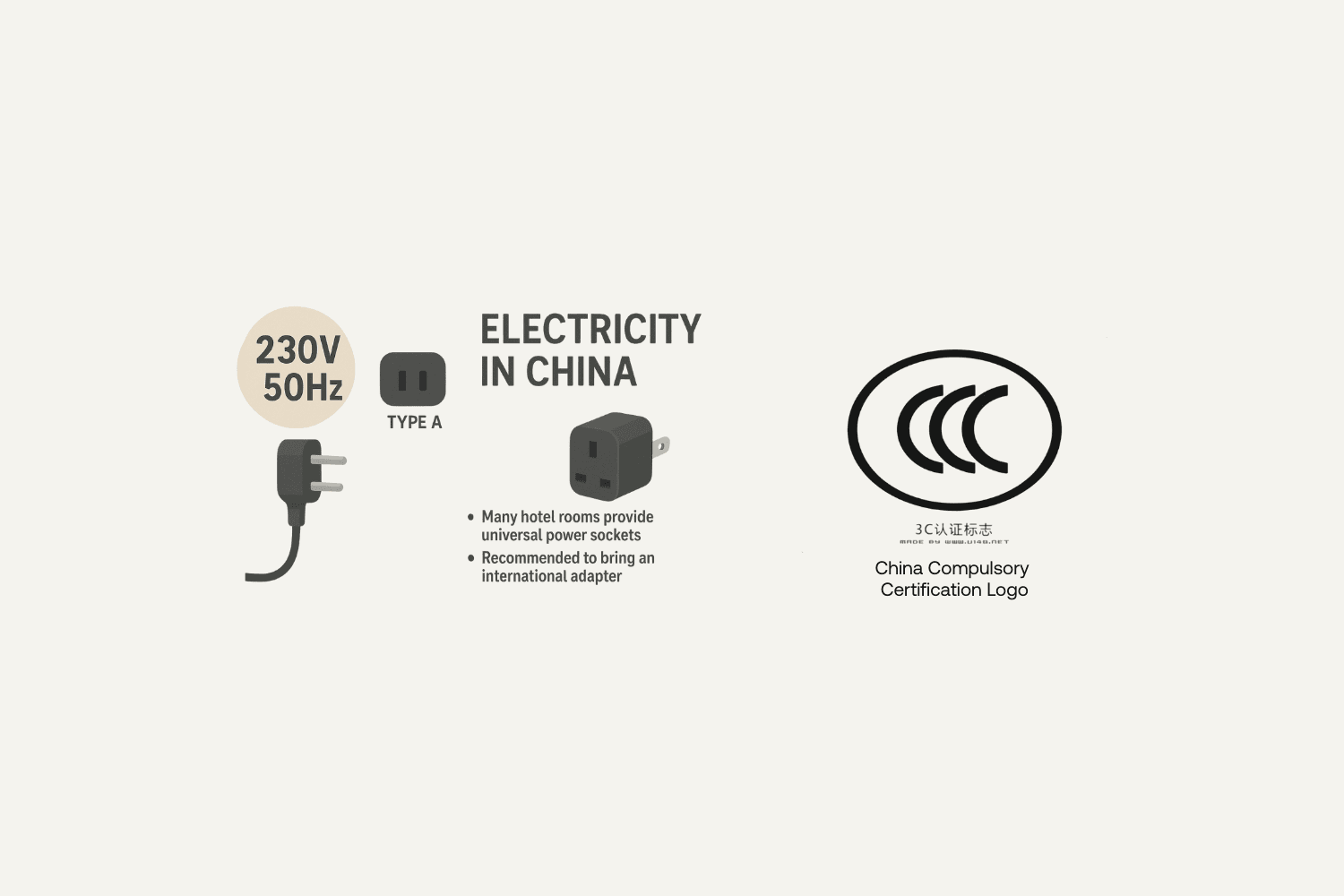
China operates at a standard voltage of 230 V at 50 Hz. While many hotel rooms provide universal power sockets, the most common plug type encountered is Type A, similar to those used in the United States (but not the US standard of 120 volts/60 Hz). To ensure seamless charging of your devices, we strongly recommend bringing a reliable international travel adapter suited to a variety of plug types.
Power Bank
Starting 2025 June 28, passengers will be prohibited from bringing power banks onto domestic flights in China if they lack a valid 3C (China Compulsory Certification) mark, have unclear, tampered, or missing 3C labels, or belong to recalled models or production batches. Please take a look at the logo on the right.
The move comes amid a rising number of incidents involving fires and smoke caused by lithium battery products, including power banks, on board aircraft. Authorities said that in recent months, several leading power bank manufacturers have issued recalls for multiple batches of products due to safety risks posed by battery cells.
Is your power bank flight-safe?
Check these three things before boarding:
- *3C certification: Look for a “CCC” mark on the product or packaging. Scan the QR code to verify on the official certification website.
- *Recalled status: Search for your model on the national recall platform or the brand’s official website.
- *Label clarity: Faded, missing, or fake stickers are all considered non-compliant.
INTERNET AND SIM CARDS
China offers extensive internet access, particularly in cities and major tourist areas. Most hotels provide Wi-Fi, though speeds and reliability can vary, especially in more remote regions. Mobile coverage is excellent nationwide, with widespread 4G and 5G networks.
Travelers can stay connected with international roaming packages from their home mobile provider or by purchasing an eSIM in advance, which provides immediate connectivity upon arrival. Based on our recent experience, both international roaming and eSIM packages generally allow access to all major websites and applications, including those that are otherwise restricted when using local networks.
Local SIM cards are also available at airports, but for most travelers, roaming or E-Sims are the simplest and most reliable option.
Staying connected makes navigation, communication, and daily logistics much easier while traveling through China’s vast and diverse regions.
CURRENCY AND MONEY
The local currency is the Yuan. China has moved to a nearly cashless society. Foreigners can now use apps like WeChat Pay or AliPay by linking their credit card, like Apple Pay.
Please check the CNY rate here as updated.
As of June 2025:
- 1 USD ≈ 7.18 CNY
- 1 EUR ≈ 8.26 CNY
IMPORTANT: If you bring foreign currency notes (USD or EUR), ensure the bills are new, clean, and free from marks or tears. For US dollars, bills issued before 2006 are often not accepted due to counterfeiting concerns. Larger denominations, such as USD 100 or EUR 100, are generally easier to exchange and offer better rates.
TIPS (GRATUITIES)
For FITs (up to 10 travelers):
- To the guide - RMB100-200 / USD15-25 per day
- To the driver - RMB80-100 / USD12-15 per day
Large groups (10 travelers and above):
- To the guide - USD 3-5 per traveler per day
- To the driver - USD 1-2 per traveler per day
- Additional service staff: $1–3 per traveler per day. Adjust the tip based on service quality.
PERSONAL EXPENSES
While most core trip costs are included, such as accommodations, guided excursions, transportation, and entrance fees, meals are generally at your discretion, offering the freedom to explore China’s rich culinary landscape according to your own tastes and appetite. Meal costs vary by region and setting, but travelers should budget approximately $10 to $20 USD per meal, depending on whether they dine at a local eatery or opt for a more upscale experience. This flexibility is a valued part of the journey, allowing you to savor both street-side delicacies and refined regional cuisine at your own pace.
China has been moving steadily toward a largely cashless payment environment for well over a decade. Mobile payment platforms such as WeChat Pay and Alipay are now the dominant payment methods nationwide. Both platforms are open to foreign travelers and can be installed in advance, allowing you to link an international credit card and pay as a local resident would. We strongly recommend setting one of these up before arrival, as it greatly simplifies day-to-day transactions.
That said, cash has not disappeared entirely and is still accepted in many places. However, receiving change can occasionally be an issue, particularly outside major cities. Carrying a small amount of local currency in small denominations is therefore advisable and should be sufficient for occasional cash payments.
For personal expenses such as meals not included in the program, coffee, small purchases, and occasional laundry, budget around USD 50 per person per day, plus a small emergency reserve. Many 4-star hotels now offer complimentary laundry services, further reducing out-of-pocket costs.
With mobile payments in place and a modest cash backup, managing expenses in China is typically smooth and straightforward, allowing you to focus fully on the experience.
China’s international grocery store presence is concentrated in major urban centers such as Beijing, Shanghai, Guangzhou, and Shenzhen, where chains like Carrefour, Walmart, Metro, and Costco offer a wide range of imported products. Convenience stores, including 7-Eleven, FamilyMart, and Lawson, also operate primarily in eastern and southern cities. Premium retailers such as Ole’, CitySuper, and BLT Market cater to expatriates and affluent shoppers in select locations. In remote regions, including Tibet (Lhasa, Yanjing), Badain Jaran, and western China’s smaller towns, international grocery options are minimal or nonexistent, with imported goods available only in small local shops or hotel outlets serving tourists.

HEALTH
China’s healthcare system presents a spectrum of services. Major metropolitan centers such as Beijing, Shanghai, and Guangzhou offer modern hospitals with Western-level medical facilities and multilingual staff. In contrast, rural and remote areas may have more limited infrastructure and may rely on traditional Chinese medicine, which may be unfamiliar to some Western visitors. In cases of serious medical concerns, treatment in top-tier urban hospitals is advisable.
Altitude Considerations:
Most accommodations in our curated itineraries are below 2,500 meters, mitigating the risk of altitude sickness for most travelers. However, mild symptoms can still occur; we advise maintaining hydration, monitoring well-being closely, and allowing acclimatization of days within your travel schedule. For journeys extending into Tibet, where elevations exceed 3,000 meters, medical consultation prior to travel is essential. Prescription medication for altitude sickness may be recommended. Early recognition of symptoms, such as headaches, nausea, dizziness, or breathlessness, is crucial; travelers should promptly inform their guide if any discomfort arises.
TRAVEL HEALTH INSURANCE
Valid travel insurance is mandatory for all travelers. Your policy must include coverage for medical evacuation, including emergency air transport back to your home country or to another country with appropriate care if needed.
A suitable policy for travel in China should cover:
- Emergency medical treatment, including hospital care, tests, and prescription medication
- Medical evacuation to another city in China or abroad if specialist care is required
- Repatriation to your home country in case of serious illness or accident
Hospitals in major cities such as Beijing, Shanghai, and Guangzhou often expect upfront payment or a formal guarantee from your insurer before treatment, especially in international clinics. In smaller cities and rural areas, facilities can be more basic, and evacuation to a higher-level hospital may be necessary.
Carry both printed and digital copies of your insurance certificate, along with your policy number and your insurer’s 24/7 emergency contact details. If anything unexpected happens during your trip, our team and local partners will assist where possible, including helping you communicate with medical staff and your insurance company.
ACCOMMODATIONS
offers a wide range of accommodations, from simple village homestays where you sleep on thin mattresses in shared family spaces, to luxurious resorts. In major cities and near key tourist sites, options range from guesthouses to high-end hotels. Unless otherwise requested, we typically reserve four-star hotels. When a four-star option is unavailable, we select the next-best option, often a three-star property or, occasionally, a well-kept guesthouse or homestay.
Standard hotel check-in is at 2 PM, and check-out is at 12 PM. Many hotels allow early check-in if rooms are available, but to guarantee this, we recommend arranging it in advance; supplements may apply. For late check-outs, it's best to inquire with the hotel reception the night before departure, though many properties offer a 2–4-hour grace period. If you're considering a triple room, be aware that few hotels in China offer proper triple rooms. Most offer a double bed with a rollaway, or a twin room with a fold-out bed. These setups may feel cramped, and the extra bed can be uncomfortable. We can certainly book a triple room if required, but we recommend considering these limitations.
When selecting accommodations, we consider location, service standards, renovation history, booking flexibility, and value. We also prioritize practical details such as breakfast quality, room cleanliness, and service responsiveness. Hotel standards can change over time, so we greatly value your feedback to help keep our recommendations accurate and up to date.
TRANSPORTATION AND TRAVEL
- The vast majority of tours in China use private vehicle transfers, typically with relatively new, well-maintained vehicles. Vehicle size is matched to group size, ranging from sedans to buses.
- The road infrastructure is generally excellent, and the Chinese government continues to invest in advancing transportation infrastructure. However, the further you move away from tourist areas and major cities, the narrower the roads become and the lower their quality. Nonetheless, most tours in China will travel on high-quality roads.
- Most tours also include domestic flights connecting various destinations within China. Generally speaking, domestic flights depart on schedule. Given China’s large domestic market, domestic flights operate large aircraft, similar to those on international routes, with comparable baggage weight limits.
- Over the past few decades, China has invested heavily in a high-speed rail ("bullet train") network connecting major destinations. Nowadays, high-speed rail replaces some domestic flights. When your tour includes train travel, please consider that:
- There is a baggage weight limit of 20 kg per adult and size restrictions (the general rule is that if it can be carried on a plane, it can be carried on the train). Weight limits are not strictly enforced, but exceeding them may cause delays at station entry.
- Entry to train stations involves security screening, including luggage scans. Items deemed dangerous (e.g., weapons, knives, sprays) may be confiscated. While rare, travelers should avoid carrying suspicious items and prefer roll-on deodorants instead of sprays.
- Some train stations are very large, making them time-consuming to traverse and find the right platforms. Due to security protocols, guides may not always be allowed to accompany travelers inside the station.
- Storage space for luggage on trains is very limited. Trains are primarily designed for daily commuters with small bags, not for tourists with large suitcases. Each carriage has a luggage rack, but it may be full by the time you board if you are not starting at the departure station.
- Given all the above, make sure you arrive at the train station in time to stand in the security queue, walk through the station, and find your platform.
NOTE: If you are traveling with heavy or multiple pieces of luggage and your itinerary includes train travel, we recommend arranging luggage transfer in advance. Luggage space on trains is limited, and handling large bags can be inconvenient. Please refer to your trip proposal, and contact us if you would like us to arrange separate luggage delivery for an additional fee, so you can travel comfortably and hands-free.
FLIGHTS AND BAGGAGE
China is served by numerous international airports, providing convenient access for both inbound and domestic travel. Key international hubs include:
Major Gateways:
- Beijing Capital International Airport (PEK): Main hub for flights to and from China’s capital.
- Shanghai Pudong International Airport (PVG): One of China’s largest airports, connecting to numerous global destinations.
- Guangzhou Baiyun International Airport (CAN): Principal southern gateway.
- Hong Kong International Airport (HKG): Major gateway for the Special Administrative Region.
- Shenzhen Bao’an International Airport (SZX): An Important airport in the Pearl River Delta region.
- Chengdu Tianfu International Airport (TFU): Rapidly growing airport in western China.
- Xi’an Xianyang International Airport (XIY): Serves Xi’an and regional carriers like Hainan Airlines.
Other Notable Airports:
- Haikou Meilan International Airport (HAK) – Hainan Island
- Sanya Phoenix International Airport (SYX) – Hainan tourism hub
- Xiamen Gaoqi International Airport (XMN) – Fujian Province
- Qingdao Liuting International Airport (TAO) – Shandong Province
These airports offer strong connectivity for both international arrivals and internal transfers, enabling efficient access to China’s major cities and tourist regions.
Exact baggage information should be listed on your flight ticket. If not clear, contact us for more information.
- As is standard worldwide, checked baggage on flights to China is limited to 20 kg in economy class (sometimes up to 25 kg, depending on the airline) and 30 kg in business class.
- Carry-on baggage is limited to 5–8 kg depending on airline policy, with size restrictions usually around 45 x 35 x 20 cm.
- Similar restrictions apply to most domestic flights within China.
FOOD
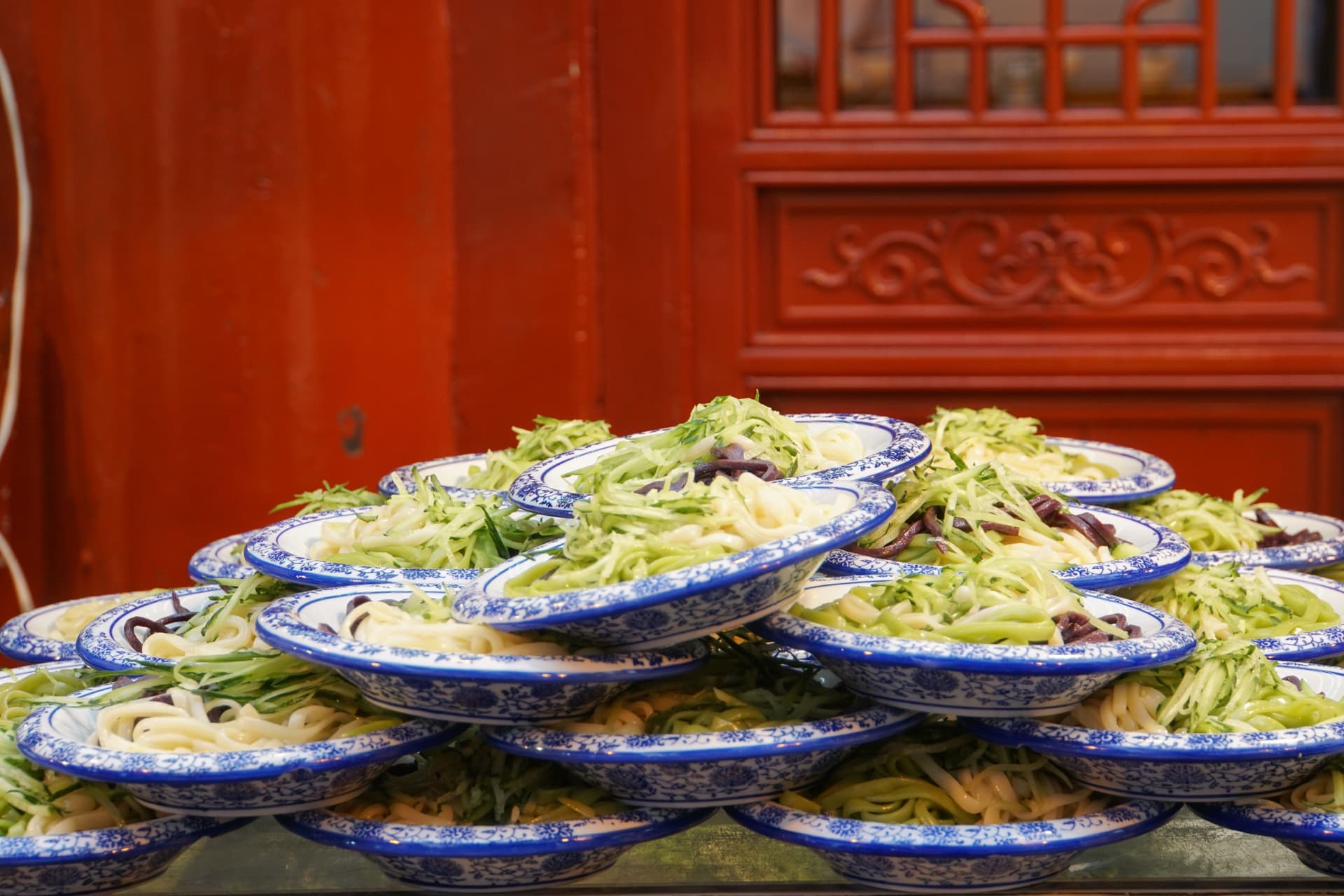
China’s cuisine is intensely regional, shaped by geography, climate, and local ingredients. Flavors can vary dramatically from one area to another, and understanding this adds an essential layer to the travel experience. In Sichuan, food is bold and aromatic, often spicy, with the signature numbing heat of Sichuan peppercorns. Cantonese cuisine (from southern China) is generally mild and fresh, emphasizing natural flavors, seafood, and lightly seasoned dishes. Jiangsu cooking is more subtle and refined, often slightly sweet, and emphasizes texture and presentation. Fujian cuisine is known for seafood, clear broths, and gentle, fragrant flavors rather than heat.
In major cities such as Beijing, Shanghai, and Guangzhou, international dining options are widely available for those who prefer familiar Western meals from time to time. In rural and remote regions, meals tend to be simpler and more traditional, prepared with local ingredients and long-standing recipes. These dishes may feel very different from Western food, but they offer an honest and memorable insight into everyday life and regional culture. Being open to local flavors, whether spicy, mild, richly seasoned, or intentionally simple, is often one of the most rewarding parts of traveling through China.
Regarding beverages, it is prudent to rely on bottled water provided by hotels, as tap water is generally not safe to drink unless explicitly labeled as filtered or purified. China’s tea culture is unparalleled, offering visitors the opportunity to savor delicate green teas, fragrant oolongs, and a variety of fermented brews, each often as rich in experience as in taste. This culinary voyage, blending boldness and subtlety, tradition and innovation, will enrich your travel experience and deepen your connection to China’s vibrant culture.
- Peking Duck: Crispy roasted duck served with thin pancakes, scallions, cucumber, and hoisin sauce, a culinary icon of Beijing and Chinese fine dining.
- Kung Pao Chicken: Stir-fried chicken with peanuts, chili peppers, and a savory-sweet sauce. Originating from Sichuan cuisine, with a balance of spice and umami.
- Dumplings: Steamed or boiled dough pockets filled with pork, beef, or vegetables. A traditional dish is often enjoyed during festivals and family gatherings.
- Mapo Tofu: Silken tofu in a spicy, numbing Sichuan pepper sauce with minced meat. A signature of Sichuan cuisine, celebrated for its bold flavors.
- Hot Pot: A communal cooking style in which thinly sliced meats, vegetables, and tofu are cooked in simmering broth at the table. Regional variations abound, including the spicy Sichuan style and the milder northern styles.
- Tsampa: A staple in Tibet, roasted barley flour is often mixed with butter tea. Fundamental for high-altitude nutrition and local tradition.
- Momo: Steamed or fried dumplings filled with yak, beef, or vegetables, common in Tibet and neighboring Himalayan regions.
CULTURAL ETIQUETTE & MODESTY NORMS
- China is a country steeped in ancient traditions, many of which derive from Taoism and Confucianism, developed between the 5th and 7th centuries BCE. Core principles include respect for hierarchy, from family to state, and values that are honored and practiced globally.
- While traditions remain highly respected, even younger city dwellers maintain these customs despite modern appearances. The Chinese are generally patient and understanding and will forgive minor cultural mishaps.
- For travelers, personal respect is paramount. Respect the locals, your hosts, and yourself. Remember, you are guests in a foreign country.
- Avoid loud conversations in your own language and refrain from jokes that might seem disrespectful or misunderstood. Remember! Sense of humor is endemic! A joke that might be a “killer” in your language and color might not go through as well in other places.
- Accept local lifestyles without judgment; their customs may seem strange or exotic, but they are deeply rooted in their culture. Appreciate, absorb, and learn without criticism.
SMOKING POLICY
- Smoking is prohibited in public places. However, many Chinese men smoke, making it relatively easy for smokers to find designated areas.
- Please adhere strictly to hotel smoking policies; some allow smoking in lobbies or rooms, while others prohibit it entirely. If smoking in a non-smoking hotel room, prepare for hefty fines and consequences.
Key Cultural Guidelines
- “Saving Face” is crucial: Always preserve the dignity of those you interact with. Even if you suspect dishonesty or uncooperativeness, avoid raising your voice or confrontation. Causing embarrassment will close doors rather than open them.
- Try to offer compromises or change the subject rather than confront issues directly. If needed, contact us to help mediate misunderstandings.
Upon Meeting
- People will generally introduce themselves by family name; you may respond with your first name.
- A right-hand handshake covered by the left hand is customary. Public displays of affection (hugs, cheek kisses) are unwelcome.
- Avoid direct eye contact; lower your gaze slightly as a sign of respect.
- When introduced to a group, greet the eldest or highest-ranking person first.
Conversation
- Expect personal questions asked out of curiosity, not intrusion. Answer openly and warmly; if a question is intrusive, politely deflect without showing anger.
- Avoid sensitive political topics such as Tibet, Taiwan, Tiananmen Square, the Cultural Revolution, and human rights.
- Chinese people rarely say a direct “no.” They may respond ambiguously to avoid conflict.
- Facial expressions tend to be neutral; avoid expressive gestures that may be misinterpreted. Maintain a “poker face” during discussions.
- Never point a finger at someone’s face; this is deeply insulting.
At Meals
- Dishes are ordered for the whole table, not individually. Diners share food from centrally served dishes.
- When resting during a meal, place chopsticks on the holder or horizontally on your rice bowl.
- Never stick chopsticks upright in rice; that gesture symbolizes death rituals.
- Avoid tapping plates or bowls; this implies dissatisfaction with the service.
- Do not put leftover bones into your food bowl; place them on the side or in a designated container.
- Certain sounds during eating are culturally accepted and express enjoyment.
- Compliment the food liberally, even if not asked, to show appreciation.
- Tipping is not obligatory but increasingly common; if given, do so discreetly.
WEATHER AND RECOMMENDED SEASONS
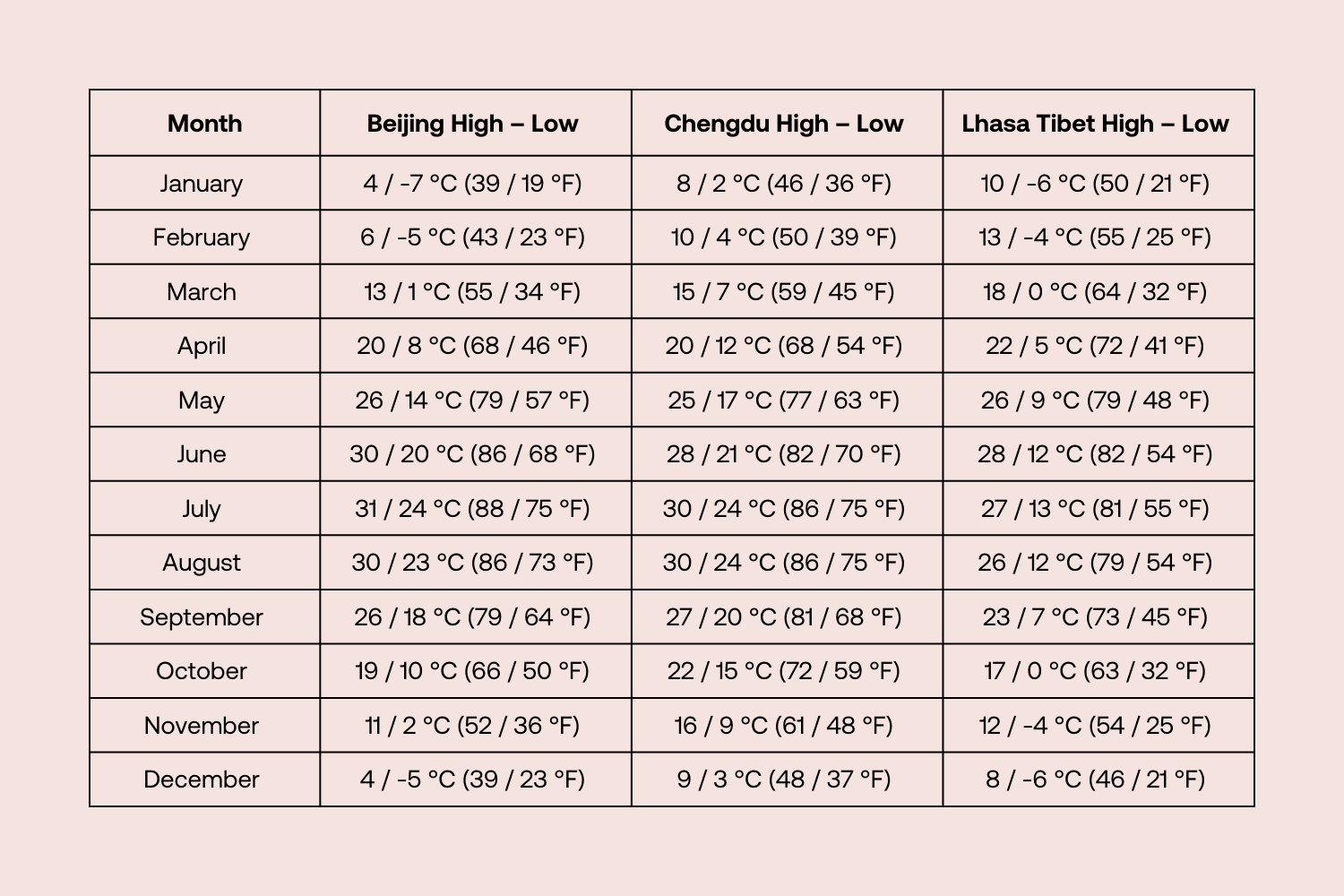
- China’s vast territory means diverse climates:
- Eastern coastal cities generally experience hot and humid weather.
- The Tibetan Plateau is cold and dry.
- Southern regions are subtropical with heavy rainfall.
- Northern areas see snow for much of the year.
- Expect multiple seasons in one day: warm days, afternoon rain, and cool evenings.
- Check typical weather for each region and season before travel and pack accordingly.
NOTES
- Hottest Month Overall: July (Beijing and Shanghai: 32–33°C; Lhasa: 23°C)
- Coldest Month Overall: January (Beijing: –9°C, Lhasa: –10°C)
- Best Months to Visit All Three: April–May and September–October
- Lhasa: High UV exposure, sun protection, and hydration are essential year-round
- Shanghai: Humid summers; rain gear is necessary from June to September
- Beijing: Winters are sunny but very cold; autumn is particularly scenic
RECOMMENDED PACKING LIST
Smart, versatile packing ensures both comfort and cultural respect while traveling through China. Here's what to include:
Essentials
- Travel insurance policy details (printed and digital)
- Digital online payment App (Alipay, Wechat) installed on your phone, and linked to your credit cards
- Local currency (RMB/Yuan) and backup credit/debit card
- International travel adapter (China: 230V, 50Hz – Type A, I, or universal)
- Unlocked smartphone + local SIM card/e-SIM installed/ or roaming enabled
- VPN app installed if you wish to access Google, WhatsApp, or Western sites
Clothing (Layered for Flexibility)
- Lightweight tops (cotton, linen, moisture-wicking)
- Long-sleeve shirts for sun and cultural sensitivity
- Warm layer (fleece or insulated jacket, especially for autumn/spring travel)
- Waterproof jacket or windbreaker
- Comfortable walking shoes (terrain may vary)
- Sandals or slip-ons (for hotel or light walking)
- Modest attire for temples or rural visits (cover shoulders and knees)
- Smart-casual outfit for fine dining or cultural events
- Undergarments & sleepwear
- Sunhat or cap, scarf, and light gloves (in colder seasons)
Toiletries & Health
- Prescription medications (with original labels)
- Basic first-aid kit (pain relievers, motion sickness pills, etc.)
- Altitude sickness medication (if visiting Tibet or high elevations)
- Hand sanitizer, wet wipes, and toilet paper/tissues (public toilets may lack supplies)
- Sunscreen (SPF 30 or higher) and lip balm
- Bug repellent (especially for southern China in summer)
- Travel-size toiletries (hotels may not provide Western brands)
- Reusable water bottle (hotels often provide filtered water)
- Travel pillow and eye mask for flights or long train rides
- Small travel laundry kit or laundry service allowance
HISTORY
China’s history is a tapestry woven over more than four millennia, where myth, philosophy, empire, and innovation converge. Early dynasties such as the Xia, Shang, and Zhou laid the foundations of Chinese civilization, introducing writing, bronze craftsmanship, and early forms of centralized governance. The Qin dynasty, though brief, unified the fragmented states, standardized laws, currency, and measurements, and commenced construction of the Great Wall, a testament to strategic ambition and engineering prowess. The Han dynasty solidified the empire’s structure, opened the Silk Road, and embedded Confucian principles into society, a philosophical framework that continues to influence Chinese thought.
The succeeding centuries saw remarkable achievements in art, literature, and science. The Tang dynasty became a golden age of cosmopolitan culture and poetry, while the Song dynasty pioneered printing, ceramics, and technological innovation. The Ming dynasty left a legacy of architectural brilliance, exemplified by the Forbidden City in Beijing and the reinforcement of the Great Wall, blending aesthetics with formidable defense. The Qing dynasty, China’s last imperial rule, extended territorial boundaries while navigating foreign pressures and internal reforms, leaving behind both splendor and challenges that would shape the modern nation.
The fall of the Qing dynasty in 1912 marked a dramatic turning point: centuries of imperial rule gave way to the Republic of China. The early 20th century was turbulent, defined by efforts at modernization, foreign influence, internal conflicts, and the scars of Japanese occupation in the 1930s and 1940s. Following the establishment of the People’s Republic of China in 1949, sweeping social and economic reforms transformed the country, gradually bridging tradition with industrialization and laying the foundation for its contemporary global presence.
For travelers today, China is a living archive of humanity’s ingenuity and endurance. In Beijing, the Forbidden City and the Temple of Heaven reveal the grandeur of imperial ceremonial life, while the Great Wall winds across mountains and deserts, a symbol of both protection and human ambition. Xi’an’s Terracotta Army commemorates millennia-old military and artistic achievement, while the waterways of Suzhou and Hangzhou reflect centuries of commerce, art, and philosophy. From the terraced rice fields of Yunnan to the arid Gobi landscapes in the north, regional diversity underscores the resilience and adaptability of Chinese civilization.
Beyond monuments, China’s history is alive in daily life: in intricate festivals, local crafts, culinary traditions, and enduring rituals that echo for millennia and reflect cultural pride. Exploring the country is more than sightseeing; it is an immersive journey into a civilization that has shaped global history, offering profound insights into human ambition, artistry, governance, and the enduring pursuit of meaning. For travelers seeking to understand the depth and scope of this vast nation, China offers a rich, layered experience that connects the past with the present at every turn.
RELIGION
China’s spiritual landscape is as intricate and enduring as its history, an enduring mosaic woven from Taoism, Confucianism, Buddhism, and folk beliefs that have shaped the cultural fabric for millennia. These traditions coexist with remarkable harmony, influencing daily life, philosophy, art, and social values in subtle yet profound ways.
Confucianism is less a religion and more a guiding ethical system that emphasizes filial piety, social harmony, respect for hierarchy, and moral integrity. Its principles continue to underpin family structures and societal interactions, informing both personal conduct and governance.
Taoism, the indigenous spiritual tradition, teaches living in harmony with the Tao, the natural flow of the universe. Its teachings inspire reverence for nature, simplicity, and balance, expressed vividly through ancient temples, sacred mountains, and rituals that honor the rhythms of life and the cosmos.
Buddhism, introduced from India over two millennia ago, found fertile ground in China, blending seamlessly with native beliefs. It offers teachings on suffering, compassion, and enlightenment, profoundly influencing Chinese art, literature, and meditation practices. Beyond these, folk religions and ancestor worship remain vibrant, reflecting a deep respect for lineage and the unseen forces believed to guide and protect families and communities.
While religious practice in modern China navigates complex social and political landscapes, these traditions endure quietly yet powerfully, offering travelers not only glimpses into spiritual practices but also keys to understanding the values and worldview of the Chinese people.
Visitors are encouraged to approach religious sites and rituals with respect and mindfulness, appreciating their timeless significance and the tranquility they impart amid China’s dynamic modernity.
GEOGRAPHY
China covers approximately 9.6 million square kilometers, making it the fourth-largest country in the world by land area. Its vast territory encompasses an extraordinary variety of climates, landscapes, and ecosystems.
Stretching from the tropical and subtropical zones of southern provinces such as Yunnan and Guangdong, China extends northward into frigid subarctic regions bordering Siberia. The country’s topography is profoundly varied:
- Mount Everest (Qomolangma) on the border with Nepal is the world’s highest peak at 8,848.86 meters (29,031.7 feet).
- The Tibetan Plateau, known as “the Roof of the World,” averages over 4,500 meters (14,764 feet) above sea level and profoundly influences Asia’s climate and hydrology.
- To the northwest lie vast deserts such as the Taklamakan and the Gobi, among the world’s most arid and harsh environments.
- Eastern China is dominated by fertile plains and river deltas, including the expansive Yangtze and Pearl River Deltas, which are economic powerhouses.
- The Yangtze River, China’s longest at 6,300 kilometers (3,917 miles), and the Yellow River (Huang He), the cradle of Chinese civilization, both flow from the western highlands to the eastern seaboard, supporting agriculture and millions of inhabitants.
China’s geographic diversity supports a wealth of flora and fauna and has nurtured distinct regional cultures. Its coasts host some of the world’s largest cities, Shanghai, Guangzhou, and Shenzhen, where cutting-edge urban development meets centuries-old history.
For travelers, this vast and varied landscape offers an incomparable spectrum of experiences, from high-altitude treks on sacred mountains and tranquil river cruises to explorations of vibrant megacities and serene countryside villages.
RECOMMENDED BOOKS
- The Search for Modern China by Jonathan D. Spence – Comprehensive overview of China’s historical evolution, providing context for major cities and landmarks.
- China: A History by John Keay – Accessible narrative covering dynasties, cultural shifts, and regional differences.
- The Silk Roads: A New History of the World by Peter Frankopan Illuminates China’s historical role in global trade and cultural exchange, useful for understanding Silk Road destinations.
- Wild China (companion book to the documentary) – Explores landscapes, natural beauty, and cultural practices that travelers can experience firsthand.
- China in Ten Words by Yu Hua – Provides insight into modern Chinese society and the social undercurrents travelers may observe.
- Factory Girls by Leslie T. Chang – Explains urban migration and industrial China, giving context to the modern cities travelers visit.
- River Town: Two Years on the Yangtze by Peter Hessler – A foreigner’s personal perspective of life along the Yangtze River, blending culture, history, and travel.
- Red Sorghum by Mo Yan – Captures rural life, history, and Chinese traditions through powerful storytelling.
- Balzac and the Little Chinese Seamstress by Dai Sijie – Offers a perspective on cultural revolution-era China, focusing on youth, education, and literature.
- The Three-Body Problem by Liu Cixin – Modern science fiction reflecting contemporary Chinese scientific culture, a fun cultural twist for tech-savvy travelers.
RECOMMENDED MOVIES
- Hero (2002, Zhang Yimou) – Epic storytelling that doubles as a visual tour of historical sites and ancient architecture.
- Raise the Red Lantern (1991, Zhang Yimou) – Insight into social structures, traditional rituals, and architecture in early 20th-century China.
- The Last Emperor (1987, Bernardo Bertolucci) – Real palace locations and historical context of the Qing dynasty.
- Wild China (BBC, 2008) – Stunning visuals of China’s natural landscapes, ethnic diversity, and rural traditions.
- China: A Century of Revolution (PBS, 1989) – Helps travelers understand the political transformations that shaped modern China.
- Last Train Home (2009, Lixin Fan) – Offers a human perspective on the migrant experience and the challenges of domestic travel.
REVIEWS
“Itravel a lot, and it was one of the most beautiful and fun tripsI've ever had. We traveled in a nice group with trips @ Asia. The organization was great, everything kicked up properly, including the bus and new bullet train trips as well as accommodation arrangements in the good hotels and a connection to a local Tibetan guide who took care ofall of histravellers and added authentic stories from his life in the area. We visited great reserves and sites -Bipangshash reserves with pandas,Mugatsu reserves with thecoloured lakes The various turquoise, the crazy valley of the nine villages in a variety ofcolours. There were also unplanned surprises but simply taking advantage of opportunities – like entering a Tibetan family home that agreed to receiveus, or joining a traditional wedding that was held in our way. I highly recommend traveling with this company!”
- FARAWAY on Tripadvisor
“A very well organizedtwo weeks tour, that managed to mix in a wonderful way a variety of cultural experiences of Tibet with amazingdifferent types of nature reserves. It wasa perfect timing for the magnificent fall colors and thedifferent types of water phenomenaat the background. Although it wasquit intense with lots of different things that we met on the way, the whole trip was arrangedin such a good vibe that it was somehow even relaxing. Ron Oren, the tour organizer and Jay, the local Tibetan guide, worked together in operating everything in a smooth way, and opening for us a window to an unknownvery interesting cultural and geographicalterritories..”
- SARA F on Tripadvisor
“The planning and organization of the trip was excellent, the local guide was very good, we visited amazing nature reserves, we really enjoyed the trip.”
- HARRY M on Google Reviews


